
Terminal blocks are usually better for organized control panels, machinery cabinets, and power distribution systems, while wire connectors are often better for fast branch wiring, lighting circuits, compact junction boxes, and on-site installation. The best choice depends on whether the project needs structured wiring, repeated maintenance, compact space, or fast installation.
Both products create electrical connections, but they solve different problems.
Choose terminal blocks when the wiring must be labeled, inspected, expanded, or maintained inside a control cabinet. Choose wire connectors when installers need a quick, compact, and tool-light connection for lighting, building wiring, or small equipment.
What Is a Terminal Block?
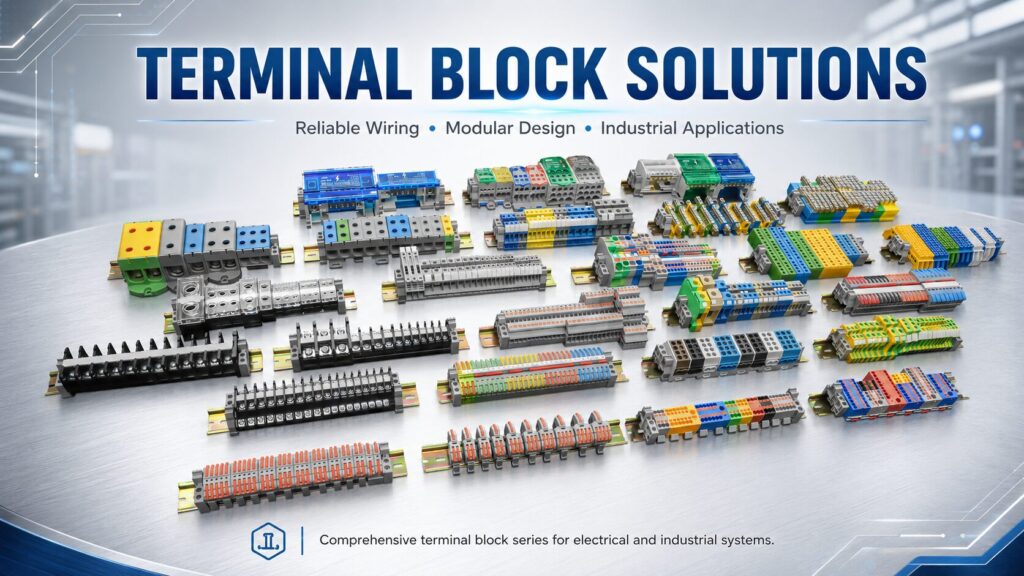
A terminal block is a modular insulated connector used to terminate and connect wires in an organized way. It is widely used in electrical cabinets, industrial machinery, power distribution, automation panels, and building systems.
Common terminal block types include:
- Screw terminal blocks
- DIN rail terminal blocks
- Ceramic terminal blocks
- Distribution blocks
- SAK terminal blocks
- UK terminal blocks
- PTFIX terminal blocks
Terminal blocks are popular because they keep wiring neat and traceable. They also make inspection and troubleshooting easier.
What Is a Wire Connector?
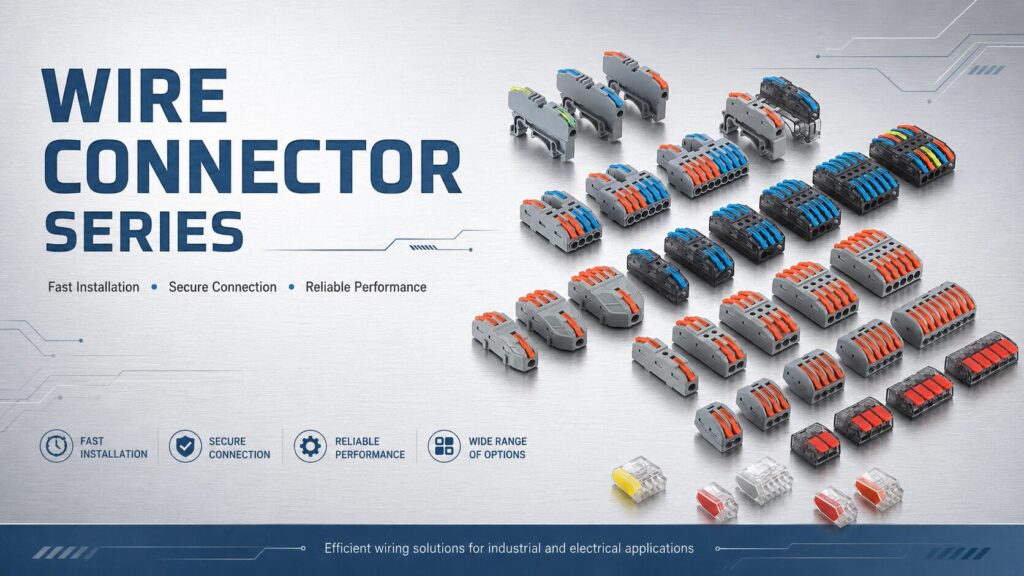
A wire connector is designed to join electrical conductors quickly and securely. Push-in wire connectors, lever wire connectors, quick splice connectors, and spring wire connectors are often used where speed and compact size matter.
Wire connectors are common in:
- Lighting installation
- Junction boxes
- Home wiring
- Device wiring
- HVAC and appliance wiring
- Small distribution points
Transparent lever connectors are especially useful when installers need to visually confirm conductor insertion.
Comparison Table
| Factor | Terminal Block | Wire Connector |
|---|---|---|
| Best use | Control panels and cabinets | Fast field wiring |
| Maintenance | Easy to inspect and label | Good for compact connections |
| Installation speed | Medium | Fast |
| Expansion | Strong | Limited by connector type |
| Space requirement | Needs rail or panel layout | Very compact |
| Typical products | DIN rail terminal block, distribution block | Push-in connector, lever connector |
When to Use DIN Rail Terminal Blocks
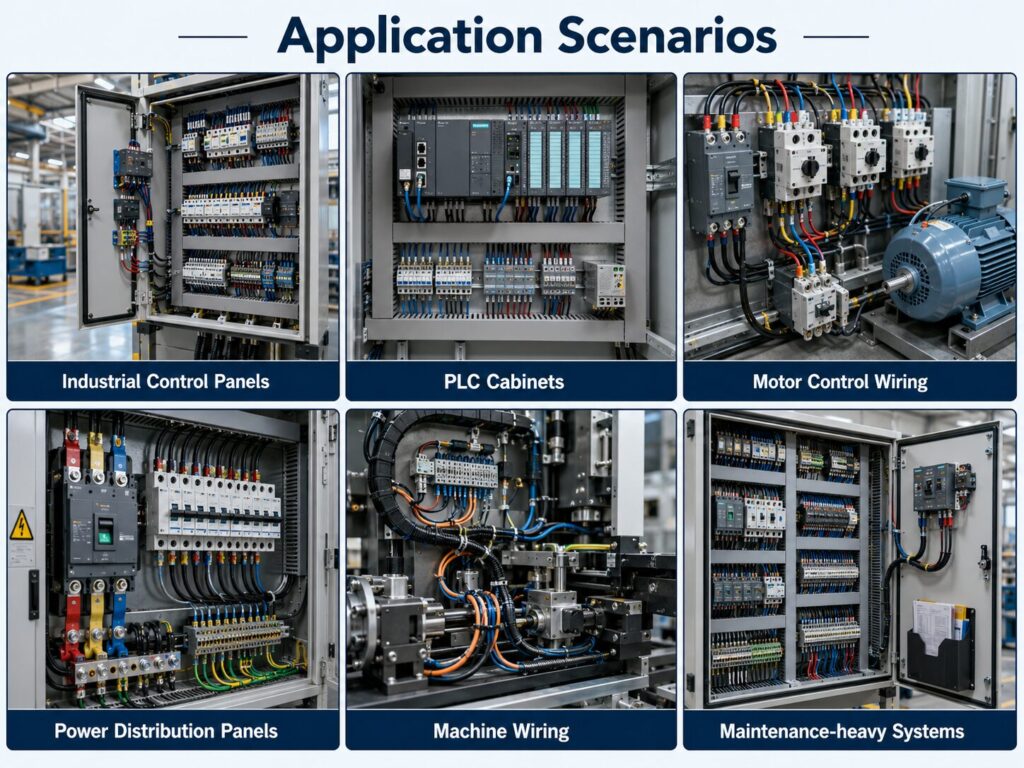
DIN rail terminal blocks are ideal when the electrical system needs a professional cabinet layout. They allow installers to arrange wires by function, phase, circuit, or control signal. This is useful for factories, equipment manufacturers, electrical panel builders, and automation companies.
Use DIN rail terminal blocks for:
- Industrial control panels
- PLC cabinets
- Motor control wiring
- Power distribution panels
- Machine wiring
- Maintenance-heavy systems
When to Use Push-In or Lever Wire Connectors
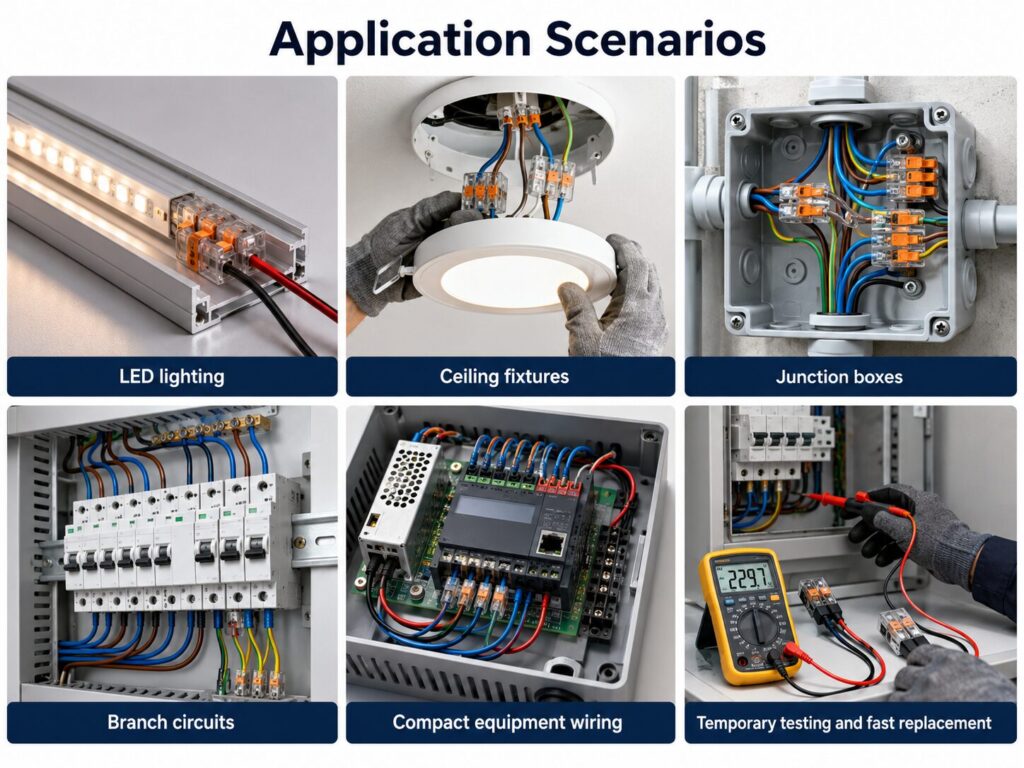
Push-in and lever wire connectors are useful when installation speed is critical. They reduce wiring time and help create reliable connections without complex tools. Lever connectors are especially helpful when stranded or solid wires need to be connected and removed during maintenance.
Use wire connectors for:
- LED lighting
- Ceiling fixtures
- Junction boxes
- Branch circuits
- Compact equipment wiring
- Temporary testing and fast replacement
What About Distribution Blocks?
Distribution blocks are used when one power input must be distributed to several outputs. They are common in electrical cabinets, building distribution, photovoltaic support systems, and equipment power wiring. Compared with small wire connectors, distribution blocks are better for higher-capacity and more organized power branching.
How Buyers Should Decide
Ask these questions before choosing:
- Will the connection be inside a cabinet or field junction box?
- Does the circuit require labels and future inspection?
- Is the installer trying to save wiring time?
- Is the connection temporary, removable, or permanent?
- What voltage, current, and wire size are required?
- Does the project need flame-retardant or high-temperature material?
JINH Product Support
JINH supplies terminal blocks, DIN rail terminal blocks, distribution blocks, push-in wire connectors, lever connectors, waterproof connectors, and related electrical accessories. For OEMs, distributors, and panel builders, JINH can help match connector type to application, wiring method, and market requirements.
FAQ
Are terminal blocks safer than wire connectors?
Neither product is automatically safer. Safety depends on correct rating, material, installation, wire size, and application. Terminal blocks are better for organized panels, while wire connectors are better for compact and fast wiring.
Can wire connectors replace terminal blocks?
Wire connectors can replace terminal blocks in some small wiring applications, but they are not always suitable for structured control cabinets or systems that need labeling and frequent inspection.
Which connector is best for control panel wiring?
DIN rail terminal blocks are usually the best choice for control panel wiring because they support organized layout, maintenance, and circuit identification.


