
Push in Wire Connector
Push in wire connects require no wiring skills; simply plug in the wire to use.
Quick Quote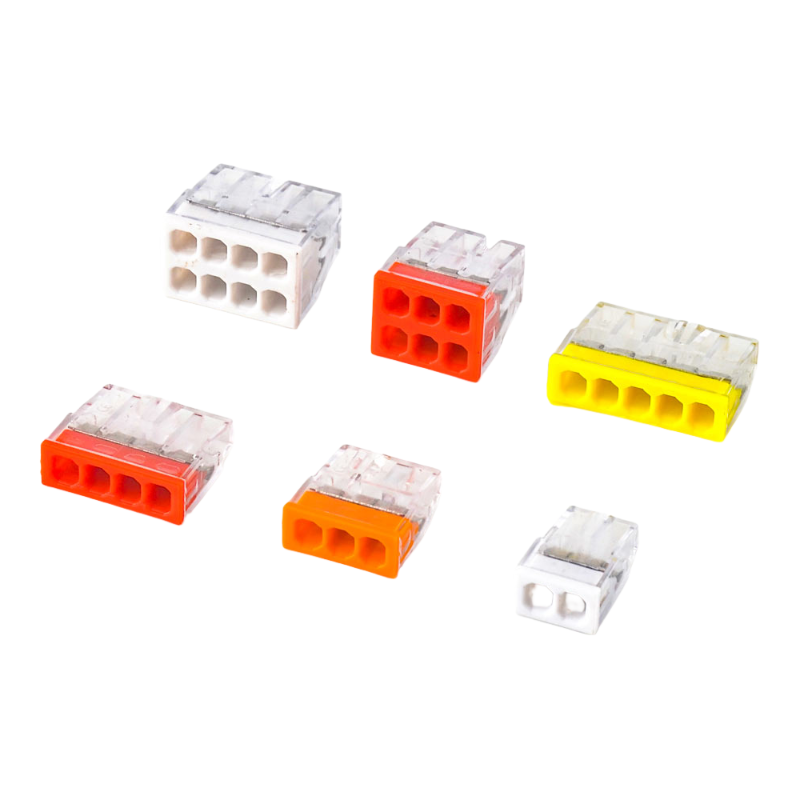
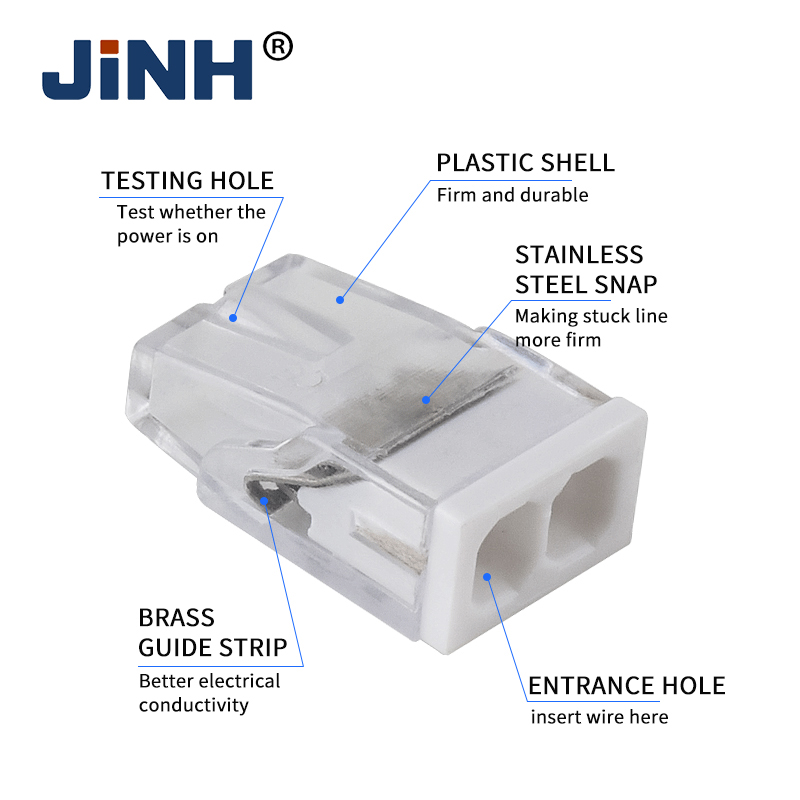
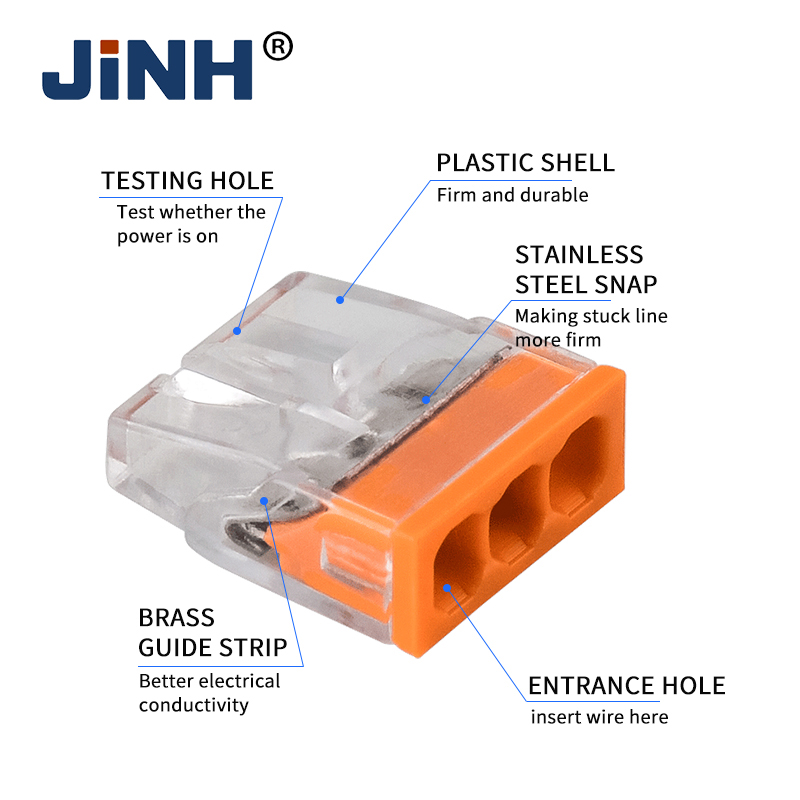
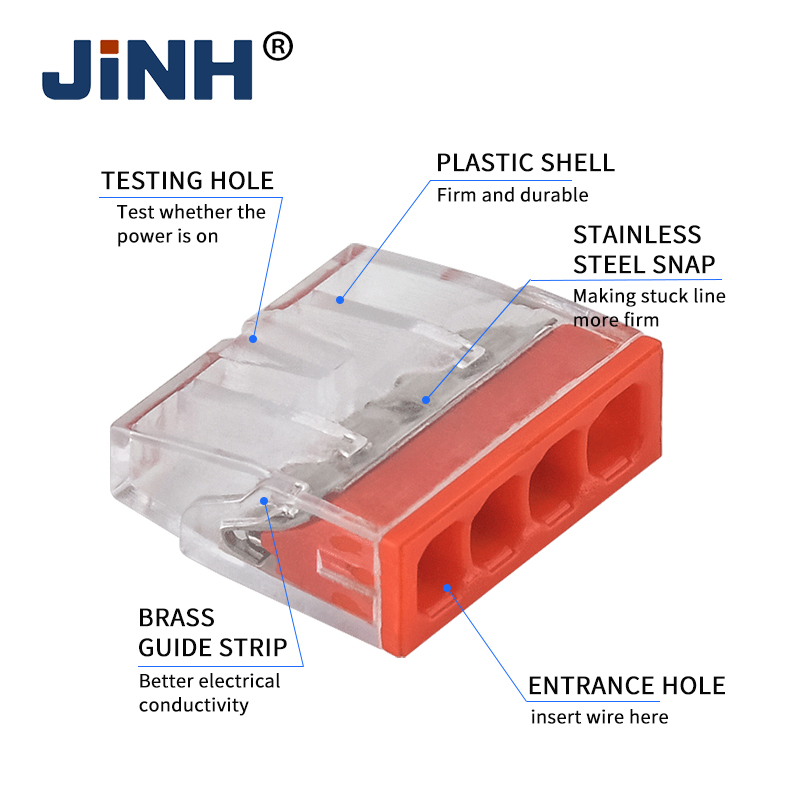
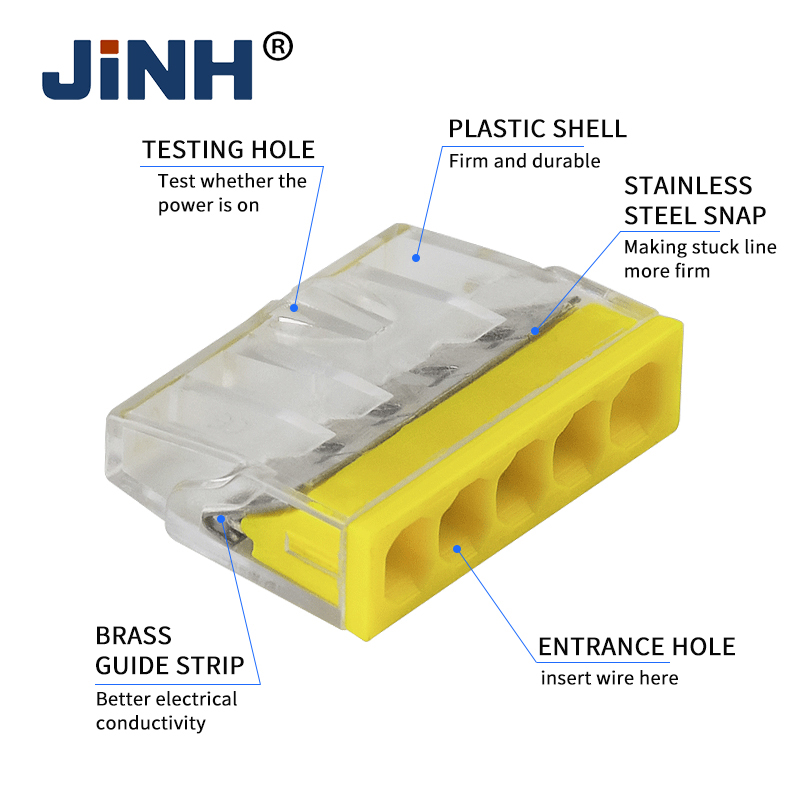
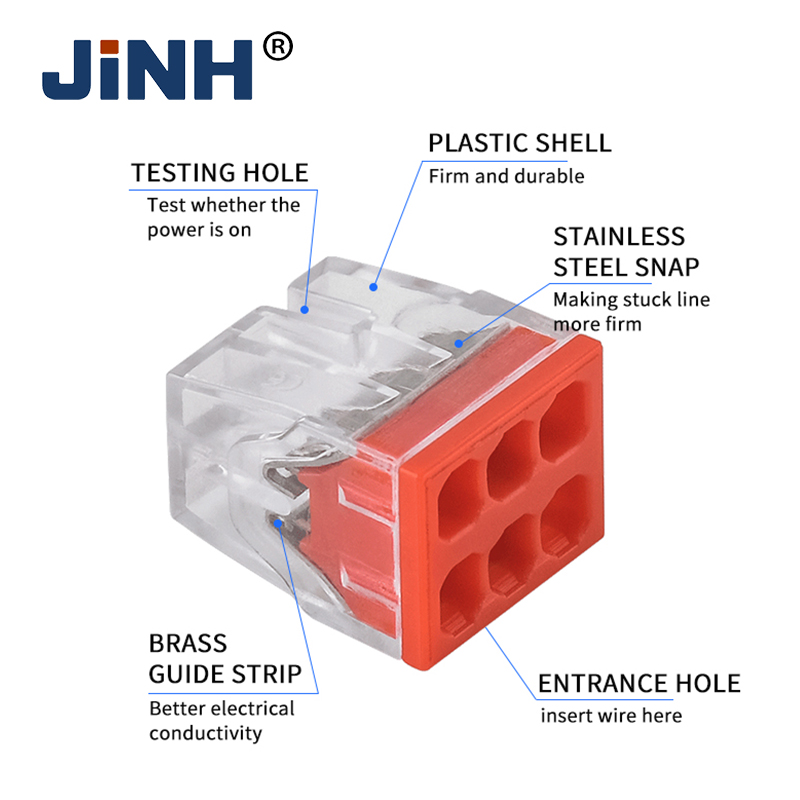
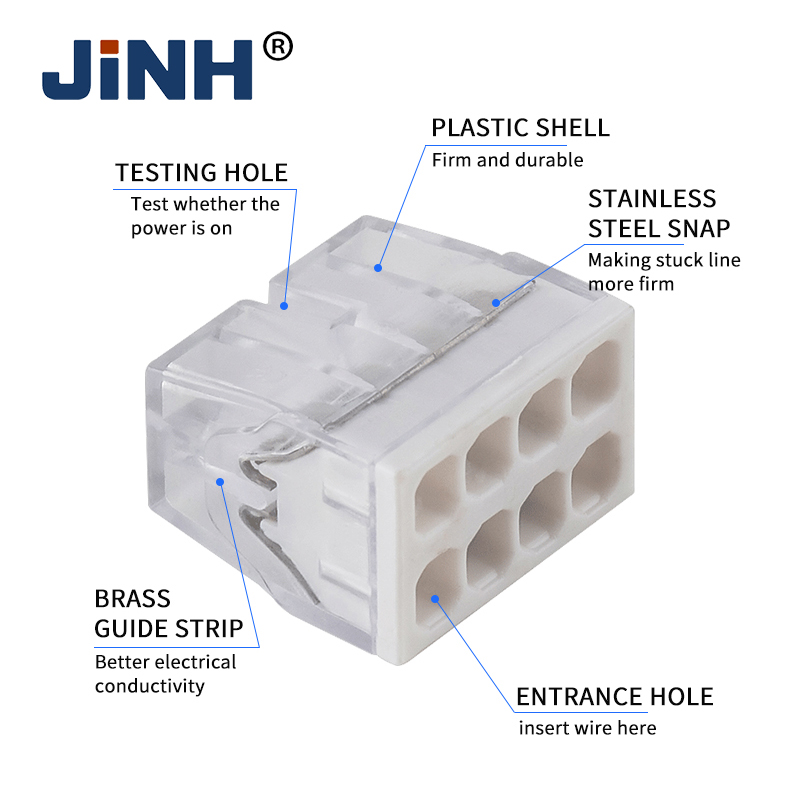
JINH Push in Wire Connector
Understanding JINH Push in Wire Connector can help you choose the right product for your project.
- 1.-40℃~85℃
- 2.AISI 301 stainless steel
- 3.strip length:10mm/0.39inch
- 4.Wiring area:0.5-2.5mm²


Push in Wire Connector Introduction Video
Send Inquiry NowHow is the Push in Wire Connector
The Push-in Wire Connector is an innovative electrical connection solution. Simply insert the stripped wire into the terminal hole and the internal spring mechanism automatically locks the wire, completing the connection in 1 second and saving up to 80% of time compared to traditional terminals.
Send Inquiry Now
High Efficiency of JINH Push in Wire Connectors
Leveraging its revolutionary tool-free installation design, the push-in wire connector is becoming an ideal wiring solution for home renovation, industrial automation control, and electronic DIY projects. The primary technical advantage of this connector lies in its built-in vibration-resistant spring clamping mechanism, which not only easily accommodates solid wires (single-strand conductors) and stranded wires with ferrules but also creates a gas-tight connection to prevent loosening and arcing, thereby significantly enhancing the long-term stability and safety of electrical connections. Compared to traditional screw terminals or soldering processes, push-in terminal blocks can save electricians up to 80% of installation time. Their compact, modular design helps optimize the internal space layout of distribution boxes and control cabinets, while the integrated push-button makes circuit inspection and wire replacement extremely convenient, effectively reducing equipment downtime during maintenance.
Application Scenario

Light Fixture Wiring

Electrical Switch and Outlet Wiring

Junction box

LED lighting

Industrial Control Cabinet

Pre-wired cabling system
Benefits of using Push in Wire Connectors

Tool-free operation, saving time and effort
No screwdrivers, soldering irons, or other tools are needed; simply insert the stripped wires into the connector to complete the wiring. This can save up to 80% of installation time.

Reliable connection
The built-in special spring not only requires less insertion force when wiring, but also provides a strong pull-out force, forming a vibration-resistant and airtight connection to prevent loosening due to vibration.

Wide range of applications
Suitable for various conductor types, whether it is solid wire (single-strand wire) or stranded wire with cold-pressed ends (multi-strand wire), it can reliably connect.

Space-saving and flexible in design
The connector itself has a compact design, which helps optimize internal space in equipment. It is especially suitable for situations where cable lengths cannot be determined in advance and on-site fabrication is required.

Easy to maintain
Many connectors have color or number codes, which effectively prevents incorrect wiring and makes inspection and disassembly very simple.
Resource


Push in Wire Connector FAQ
Yes, push-in wire connectors are highly reliable and fully compliant with international electrical standards when used correctly. Unlike wire nuts that rely on twisting force, push-in connectors utilize a corrosion-resistant stainless steel spring clamp. When a wire is inserted, the spring exerts a constant, high-retention force on the conductor, ensuring a gas-tight connection that resists vibration and temperature fluctuations. They are certified to strict standards such as UL, CE, RoHS. For professional installers, they actually reduce the risk of human error (such as under-torquing a wire nut) that can lead to loose connections.
Most standard push-in connectors are designed on a “one wire per port” basis for safety. You cannot insert two wires into a single insertion hole; this can prevent the spring from clamping properly and lead to overheating.
However, a single connector block usually has multiple ports that are internally connected (like a bus bar). This allows you to connect multiple wires together by putting each wire in its own port.
Regarding wire gauges: Yes, most modern push-in connectors are designed to accept a range of wire sizes (e.g., Solid: AWG 24–12). You can connect a smaller gauge wire in one port and a larger gauge in another port within the same connector, provided both sizes fall within the connector’s approved range and the current rating is not exceeded.
The difference lies in the wire’s structure.
-
Solid Wire: The rigid structure allows it to push the spring open easily and provides a large, stable contact surface inside the clamp. It is ideal for push-in connections.
-
Stranded Wire: The fine individual strands tend to splay and bend when pushed against the spring. This prevents the wire from fully entering the chamber or results in only a few strands being clamped.
Why it sometimes fails: If the strands are not bound together, they cannot push the spring mechanism open evenly. The solution is to use a ferrule (wire end sleeve). Crimping a ferrule bundles the strands into a solid tip, allowing the stranded wire to perform just like a solid wire in a push-in connector.
A ferrule, also known as a wire end sleeve, is a thin metal tube (usually tinned copper) that is crimped onto the stripped end of a stranded wire.
Why it is better:
-
Prevents Fraying: It compresses the fine strands into a solid pin, preventing individual strands from bending back or breaking during insertion.
-
Ensures Full Insertion: The solid tip guarantees the wire reaches the required depth in the terminal to engage the spring clamp correctly.
-
Maintains Conductivity: It ensures all strands are participating in the electrical connection, preventing hot spots caused by partial contact.
-
Sealing (for ferrules with a plastic collar): The plastic collar can help seal the entry point of the terminal against dust and debris.
It is important to note that “tinning” (coating with solder) is NOT recommended as a substitute for a ferrule, as solder can creep under pressure and lead to a loose connection over time.
Since push-in connectors have no screws to loosen, looseness or overheating is almost always due to installation error or misapplication rather than mechanical failure of the connector itself. Common causes include:
-
Wire Not Fully Seated: The most common cause. If the stripped portion of the wire is not fully past the spring clamp, the insulation might be inside the contact area, or the wire is only touching the spring lightly.
-
Stranded Wire Without a Ferrule: As discussed in FAQ 7, using bare stranded wire can result in only a few strands making contact, increasing electrical resistance and generating heat under load.
-
Wrong Wire Size: Using a wire gauge that is too small may not activate the spring mechanism properly, while a wire too large can damage the port.
-
Contamination: Oil, dirt, or oxidation on the wire prevents a good metal-to-metal contact. Always use clean, stripped wire.


