Home > How to Choose Waterproof Wire Connectors for Outdoor Electrical Projects

Waterproof wire connectors should be selected by matching the connector’s IP rating, voltage, current, wire size, housing material, and sealing structure to the actual installation environment. For outdoor lighting, water pumps, construction sites, garden wiring, and industrial equipment, an IP68 waterproof connector is often preferred because it helps protect the electrical connection from water, dust, corrosion, and accidental failure.

Choosing the right connector is not only a matter of convenience. A poor connection can create heat, voltage drop, short circuits, or maintenance problems. A properly selected waterproof connector gives installers a sealed, stable, and serviceable connection for harsh outdoor conditions.

What Makes a Wire Connector Waterproof?

A waterproof wire connector normally uses a sealed housing, cable gland, rubber gasket, O-ring, or gel-filled structure to prevent water and dust from reaching the conductive parts. The housing is often made from engineering plastic such as PA66, while conductive components are commonly made from copper for reliable conductivity.

For most outdoor electrical projects, buyers should check three things first:

  1. The protection rating, such as IP65, IP67, or IP68.
  2. The electrical rating, including voltage and current.
  3. The connection capacity, such as 0.5-1.5 mm2 or 0.5-2.5 mm2.

If these three items do not match the application, the connector may not perform safely even if it looks physically compatible.

CNP35-Y Waterproof Outdoor Wire Connector

IP68 vs IP65: Which Rating Should You Choose?

IP ratings describe protection against dust and water. IP65 is generally used for dust-tight products that can resist water jets. IP68 offers a higher level of water protection and is commonly selected for environments with heavy rain, outdoor exposure, wet soil, or temporary immersion conditions.

For garden lights, street lamps, underground cable branches, outdoor pumps, and construction-site wiring, IP68 waterproof wire connectors provide a stronger safety margin. For indoor panels or dry equipment cabinets, a standard terminal block or wire connector may be more cost-effective.

Match Wire Size and Current Rating

Before ordering waterproof connectors, confirm the wire cross-section and rated current. A connector designed for 0.5-1.5 mm2 cable should not be forced onto larger conductors. Oversized conductors can damage the seal or terminal, while undersized conductors may not clamp securely.

For many low-voltage and medium-load outdoor applications, 16A waterproof connectors are widely used. Higher-power equipment may require larger cable capacity, stronger terminals, or industrial plug-and-socket solutions.

Housing Material and Conductive Parts Matter

Outdoor connectors must resist temperature change, impact, moisture, dust, and aging. PA66 is widely used for connector shells because it offers good insulation, strength, and heat resistance. Copper conductive parts are preferred because they provide stable electrical performance and low resistance.

When comparing suppliers, do not only ask for price. Ask for:

  • Shell material
  • Contact material
  • Working temperature
  • Flame-retardant rating
  • Waterproof test method
  • Certification documents
  • Sample availability

These details help engineering and purchasing teams avoid hidden quality differences.

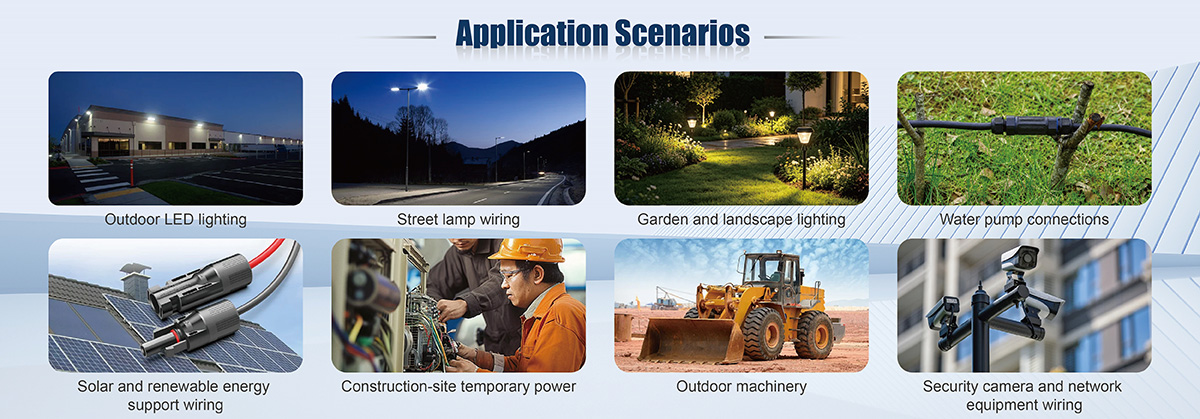
Typical Applications

Waterproof wire connectors are commonly used in:

  • Outdoor LED lighting
  • Street lamp wiring
  • Garden and landscape lighting
  • Water pump connections
  • Solar and renewable energy support wiring
  • Construction-site temporary power
  • Outdoor machinery
  • Security camera and network equipment wiring

For outdoor data equipment, waterproof RJ45 connectors may be more suitable than ordinary waterproof cable connectors.

Application Scenarios for Waterproof Wire Connectors

Selection Checklist for Buyers

Use this checklist before confirming an order:

  • Is the connector rated for the project voltage?
  • Is the rated current higher than the actual load?
  • Does the wire size fit the terminal range?
  • Is the waterproof rating suitable for rain, dust, or immersion?
  • Can the connector handle the required working temperature?
  • Is the housing material suitable for outdoor use?
  • Is the supplier able to support OEM/ODM, samples, and stable production?

Why Source Waterproof Connectors from JINH?

JINH manufactures waterproof connectors, terminal blocks, wire connectors, waterproof boxes, and other electrical connection products for global buyers. With experience dating back to 1997, JINH supports OEM/ODM connector projects, distributor sourcing, and application-based product selection for outdoor, industrial, lighting, building, and power-system applications.

FAQ

What is the best waterproof connector for outdoor wiring?

For outdoor wiring exposed to rain, dust, or humid conditions, an IP68 waterproof wire connector is usually recommended. The final choice should match the wire size, voltage, current, and installation environment.

Can waterproof wire connectors be used underground?

Some waterproof connectors are designed for underground or wet-location use, but buyers should confirm IP rating, sealing structure, cable size, and installation method before use.

What materials are commonly used in waterproof connectors?

Many waterproof connectors use PA66 engineering plastic for the shell and copper for the conductive parts. Rubber seals, O-rings, or gel components may be used to improve water resistance.

contact person: Ms Snow
Email: [email protected]
online-store

Online Store