
A power distribution block gives you a compact point for splitting one supply into several conductors. A busbar distributes a common electrical potential across a wider panel area. The better choice depends on your current path, branch count, panel space, assembly method, and expansion plan.
The Short Answer
Choose a power distribution block when you need to bring one main conductor into a defined location and connect several outgoing conductors. It is often the practical option for localized branching inside a control panel or machine.
Choose a busbar system when the common supply must extend across a larger part of the panel or connect many devices along the same power path. A busbar can provide more freedom for a distributed panel layout, but it normally requires a coordinated set of supports, covers, adapters, and connection components.
You do not always need to choose only one. A larger panel may use a busbar for the main distribution path and power distribution blocks for smaller local branch groups.
What Is a Power Distribution Block?
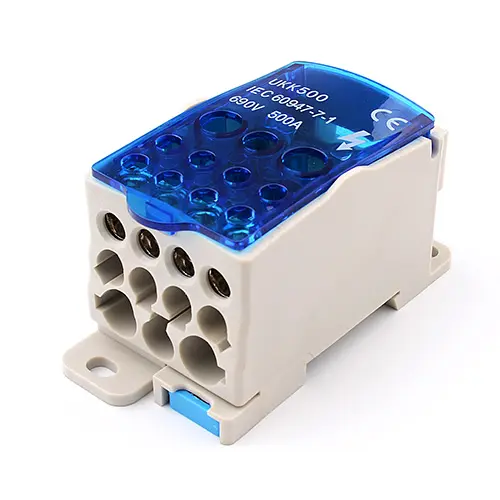
A power distribution block is an insulated electrical component that accepts one or more incoming conductors and provides several defined outgoing connection points. Its internal conductive structure distributes the same electrical potential to the permitted output terminals.
For example, you may bring one larger feeder conductor into a block and connect several smaller copper conductors that supply separate parts of a machine. The block keeps these connections in one compact location and gives each permitted conductor a dedicated terminal opening.
This structure can help you:
- Reduce improvised conductor branching
- Keep incoming and outgoing wiring easy to identify
- Standardize the connection layout across repeated panels
- Inspect the distribution point without tracing several unrelated splices
- Replace several loose connection components with one specified device
A standard power distribution block is not a circuit breaker or fuse. It distributes power but does not automatically protect each outgoing circuit. Your design still needs the appropriate protective and switching devices.
What Is a Busbar?
A busbar is a conductive bar or strip that forms a common electrical path. It is usually made from copper or aluminum and installed with suitable insulation, supports, covers, and connection accessories.
You can extend the busbar through part of the panel instead of routing a separate main cable to every distribution point. You can then connect compatible devices or branch conductors along that path. This can suit panels with many repeated connections or equipment spread across a larger mounting area.
The term “busbar” can describe very different products. A simple drilled copper bar is not the same as a complete modular busbar system. When you compare options, evaluate the complete assembly rather than comparing one distribution block with the raw price of one metal bar.
Power Distribution Block vs Busbar Comparison
| Decision factor | Power distribution block | Busbar system |
|---|---|---|
| Main function | Concentrated one-to-many branching | Common power path across a wider area |
| Connection layout | Fixed input and output terminals | Connection points depend on the system design |
| Best fit | Local distribution to several branch conductors | Panel-wide distribution or many repeated connections |
| Installation | Install one specified block and terminate the permitted conductors | Install the bar, supports, protection, and compatible connection parts |
| Panel layout | Compact and concentrated | Distributed along part of the panel |
| Expansion | Limited by spare terminals and available space | Can be planned with additional connection positions |
| Product selection | Choose a model by current, voltage, wire range, output count, and dimensions | Select the complete bar system and all compatible accessories |
| Maintenance | Defined terminals make local branches easy to identify | Access depends on the busbar design and protective covers |
| Purchasing | A standardized component with a defined model | A coordinated system with several component types |
| Typical cost question | Is one block sufficient for this local branch group? | Does the larger system reduce wiring and assembly work enough to justify it? |
Neither option is automatically better. The correct choice is the one that fits the electrical design and remains practical to assemble, inspect, and source.
When a Power Distribution Block Is the Better Choice
You need localized branching
A distribution block is well suited when the incoming supply reaches one area of the panel and then divides into a limited number of outgoing circuits. You can place the block near the loads or protective devices it supplies and keep the branch conductors relatively short.
You want a defined terminal arrangement
Each model gives you a stated input and output configuration. This makes it easier to include the component in a bill of materials, drawing, assembly instruction, and inspection checklist.
Your panel has limited space
A compact block can concentrate several branch connections in a small area. You still need enough room for conductor bends and installation access, but the component itself can simplify a crowded local distribution point.
You build several similar machines
If every machine uses the same local power split, a standard distribution block can help you repeat the layout. You can use the same part number, wiring sequence, and inspection method across production batches.
You need a practical standard product
You can stock several current ratings and terminal configurations for different panel requirements. A standard model also lets you cover a small project without designing a complete busbar system.
When a Busbar Is the Better Choice
The supply must run across a larger panel area
If several devices are positioned along a cabinet, a busbar can create a shared power path near those devices. This can reduce the need to route separate feeder cables back to one concentrated distribution point.
You have many repeated connections
A compatible modular busbar system can support multiple connection modules along the same bar. This may be useful when a panel contains many similar devices or when you produce a repeated panel design in volume.
Future expansion is part of the design
A busbar system can be planned with additional length or connection positions. That does not mean every busbar installation is automatically expandable. You must reserve the required physical space and use compatible components from the selected system.
You are designing the complete panel architecture
A busbar is not an isolated replacement for one terminal block. It affects equipment position, protection, insulation, conductor routing, covers, and assembly procedures. It is most useful when you can design these elements together.
When You Should Use Both
Many control panels use different distribution methods at different levels. One possible structure is:
Incoming supply → main protective device → busbar system → branch protective devices → power distribution blocks → local loads
In this arrangement, the busbar carries the common supply across the main panel area. Smaller distribution blocks then create organized local branches near groups of loads.
Another design may not need a busbar at all:
Incoming supply → protective device → power distribution block → several branch circuits
This simpler structure can work when the branch count is limited and all outgoing circuits are concentrated in one area. The correct layout depends on the complete electrical design, not on a rule that one component must always replace the other.
Seven Questions to Answer Before You Choose
1. What current must the distribution point carry?
Start with the actual circuit design. Do not select a product only by matching a current number in a catalog. Check how the load is divided, the conductor sizes used, and the conditions inside the enclosure.
2. How many outgoing circuits do you need?
A distribution block has a fixed number of output openings. Confirm that every outgoing conductor has a permitted terminal. If your design has many connection points spread across the panel, a busbar system may create a cleaner layout.
3. What are the incoming and outgoing conductor sizes?
Record the cross-section and material of every conductor. A block can have the correct current rating but still be unsuitable because the input or one of the outputs does not accept your conductor size.
The JINH JHUKK series is designed for copper conductors. You must not use JHUKK blocks with aluminum conductors.
4. Where are the loads located?
If all loads are close to one distribution point, a compact block may be sufficient. If they are distributed along the cabinet, compare the cable routing required by a block with the layout of a busbar system.
5. How much panel space is available?
Do not compare only component width. Include the space required for conductor bends, cable ducts, protective covers, supports, and installation access. A small component can still create a difficult layout when large conductors approach it from the wrong direction.
6. Will the panel need future expansion?
If future circuits are likely, decide how they will be added before finalizing the layout. A distribution block needs spare output terminals and cable space. A busbar needs reserved connection positions and compatible expansion components.
7. Can your supplier document the exact configuration?
Ask for the product drawing, conductor ranges, materials, dimensions, mounting method, and model identification. For a busbar, request information for the complete system. For a distribution block, make sure the documents match the exact model you will purchase.
A Simple Cost Comparison
The lowest component price does not always produce the lowest installed cost. Compare the complete work required by each option.
For a power distribution block, include:
- Block price
- DIN rail and mounting space
- Incoming and outgoing cable preparation
- Wiring and inspection time
- Number of models you must keep in stock
For a busbar system, include:
- Busbar material
- Supports and protective covers
- Connection adapters and accessories
- Cutting or assembly work
- Engineering and documentation time
- Installation training
- Space reserved for present and future devices
A power distribution block often has an advantage for a compact local branch group because it arrives as a defined component. A busbar may provide better system efficiency when the design contains many repeated connections across a larger panel. Calculate the result using your own build quantity and labor process.
Common Purchasing Mistakes
Comparing only rated current
Rated current does not tell you the conductor range, number of outputs, dimensions, material compatibility, or mounting requirement. Approve the complete model specification.
Assuming every block accepts aluminum wire
Some products are designed for copper only. The JHUKK series cannot connect aluminum conductors. Never infer conductor compatibility from the size of the terminal opening.
Treating a distribution block as a protective device
A standard block creates an electrical branch point. It does not automatically provide the protection required for each circuit.
Comparing a complete block with a bare metal bar
A usable busbar installation also needs supports, protection, and connection parts. Compare complete installed systems, not incomplete component prices.
Ignoring conductor routing
Large conductors need room to enter the terminal without excessive bending or mechanical stress. Review the panel layout with the actual cable dimensions.
Approving a product without a sample
Use your real conductors and intended mounting arrangement during sample testing. A physical trial can reveal clearance and routing problems that are not obvious in a catalog.
How JINH Distribution Blocks Fit Different Panel Layouts
JINH provides several distribution-block structures for different wiring requirements. The power distribution block range includes compact single-pole blocks and multi-connection distribution products.
The JHUKK series covers rated-current options from 80A to 500A for copper conductors. These blocks are generally mounted on a TH35 DIN rail. You can inspect the UKK500 distribution block when comparing the higher-current end of the range.
If you first need to understand local distribution inside a cabinet, read the guide to power distribution blocks for control panels. For smaller connection functions, the comparison of terminal blocks and wire connectors in control panels explains where those products fit.
Information to Send Your Supplier
Send the following information to receive a useful product recommendation:
- System voltage and design current
- Incoming conductor material, construction, and cross-section
- Outgoing conductor sizes and quantities
- Number of phases or separate electrical potentials
- Available panel and TH35 DIN rail space
- Location of the loads inside the cabinet
- Required branch layout
- Expected operating environment
- Panel drawing or clear layout sketch
- Sample quantity, annual demand, and packaging requirements
This information helps the supplier compare your application with the actual product range. It also reduces the risk of receiving a quotation for a part that has the right current label but the wrong connection structure.
Conclusion
Use a distribution block for compact, defined branching and a busbar for a wider common power path. Compare the complete layout, conductor schedule, assembly process, and expansion plan before you approve either solution.
FAQ
Is a power distribution block the same as a busbar?
No. A distribution block is a specified component with defined input and output terminals. A busbar forms a common conductive path and normally works with separate supports, covers, and connection components. Some distribution blocks contain an internal conductive bar, but the complete products are still used differently.
Can a distribution block replace a busbar?
It can replace a busbar in some compact local distribution points, but not in every panel. If the common supply must extend across a large cabinet or connect many distributed devices, a busbar system may provide a more suitable architecture.
Does a power distribution block provide circuit protection?
A standard power distribution block does not automatically provide overcurrent protection. It creates a connection and branching point. Use the protective devices required by the complete circuit design.
How do you size a power distribution block?
Check the voltage, current, incoming conductor, every outgoing conductor, number of outputs, dimensions, conductor material, and mounting space. Then test the exact model in the intended panel layout.
Can you use aluminum wire in a JHUKK distribution block?
No. JHUKK power distribution blocks are intended for copper conductors and cannot be used with aluminum conductors.
How are JHUKK power distribution blocks installed?
They are generally installed on a TH35 DIN rail. You should verify the available rail length, enclosure clearance, conductor routing, and exact model dimensions before installation.
When should you use both a busbar and distribution blocks?
You may use both when a busbar distributes the main supply across a larger panel and distribution blocks create smaller local branch groups near the loads. This can keep the panel architecture organized at different distribution levels.
What should you request from a distribution block supplier?
Request the exact model drawing, rated voltage and current, copper conductor ranges, input and output configuration, materials, dimensions, mounting information, packaging details, and a sample for validation.


