
Enclosed Distribution Blocks
Covered unipolar power distribution for industrial panels. JINH UKK and UKH blocks divide one incoming conductor into multiple outgoing circuits in a compact insulated assembly.
Quick Quote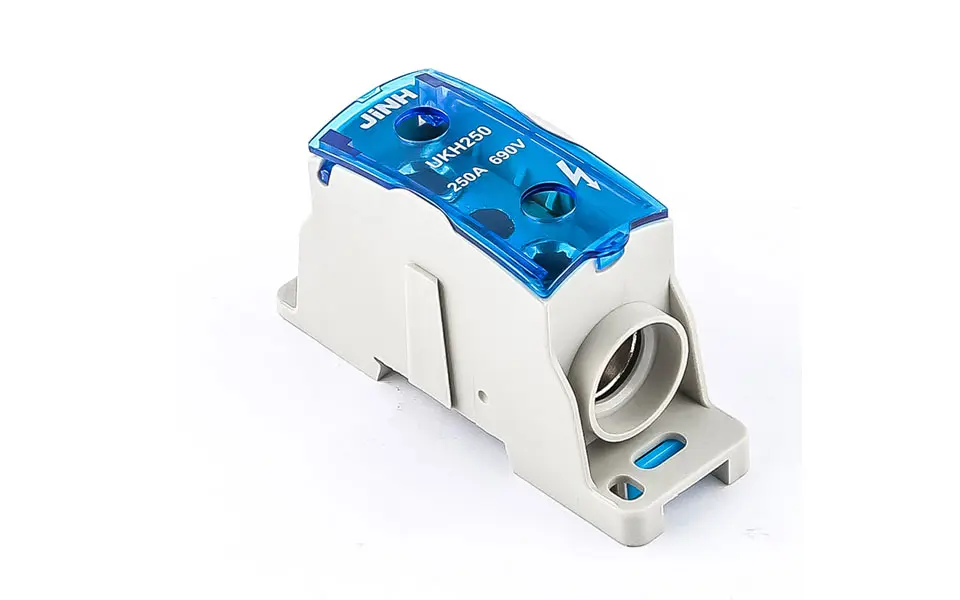
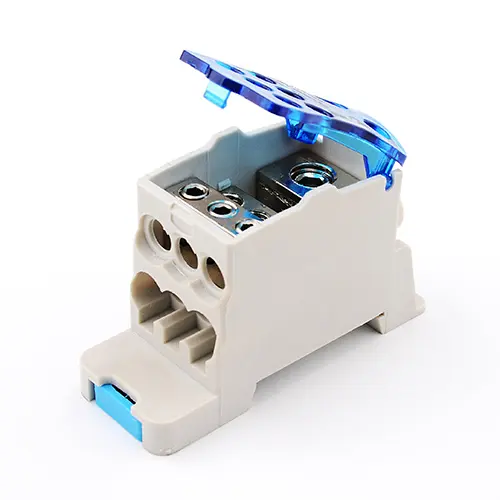
JINH enclosed distribution blocks provide an organized high-current connection point inside electrical panels and equipment. The UKK family covers compact UKK80 through UKK500, while UKH125 and UKH250 provide additional cable-distribution options.
- Rated voltage: selected models 690V IEC
- Rated current: selected models approximately 80A–500A
- Configuration: unipolar input-to-multiple-output distribution
- Mounting: DIN rail or fixed mounting, model-dependent


What Is an Enclosed Distribution Block?
An enclosed distribution block is a power-distribution component that connects one incoming conductor to multiple outgoing conductors inside an insulated housing. Unlike an empty junction enclosure, the conductive distribution element is built into the product. Unlike a multi-busbar distribution junction box, a unipolar block normally distributes one electrical potential through one defined internal path.
The correct model must be selected by conductor material and cross-section, voltage, current, number of outputs, mounting method, dimensions and applicable equipment standard.
Send Inquiry Now
Compact High-Current Distribution with a Protective Cover
UKK and UKH blocks consolidate several outgoing connections into a compact assembly. This reduces loose jumper wiring, improves repeatability and makes the distribution point easier to identify during commissioning and service.
Application Scenario

Industrial Control Panels

Machinery Power Distribution

Renewable Energy Equipment

Building Electrical Systems
EV Charging and Energy Storage

OEM Electrical Assemblies
Benefits of Using Enclosed Distribution Blocks

Covered Termination Area
The insulated body and removable cover help protect connection points during normal equipment access.

Compact Multi-Output Layout
Several outgoing connections fit in one defined footprint, reducing panel space and jumper wiring.

Broad Current Range
UKK and UKH families provide several sizes for different conductor and current requirements.

Easier Inspection and Service
Transparent covers and organized conductor entries simplify visual checking and circuit identification.

Repeatable Panel Assembly
A defined input-to-output arrangement helps production teams build and inspect panels consistently.
Resource


Power Distribution Blocks FAQ
A standard UKK or UKH block provides a common distribution point; it does not automatically provide branch overcurrent protection. Select the required protective devices as part of the complete circuit design.
Only if the exact model documentation explicitly permits that conductor combination. Do not place multiple conductors in one clamping point simply because they physically fit.
Allow space for product dimensions, cover removal, installation tools, cable-duct position and the minimum bend radius of the largest conductor. Verify the finished layout with the exact drawing and real cable dimensions.
Confirm the part number, conductor material and size, strip length, insertion depth, tightening torque, secure mounting, circuit identification and protective-device coordination. Complete required equipment tests.
Investigate abnormal temperature rise, discoloration, damaged insulation, cracked housing, corrosion, loose mounting or a conductor that fails a pull check. Isolate equipment and replace damaged parts.
Check component temperature limits, enclosure temperature, ventilation and adjacent heat sources. Maintain required clearances and improve thermal management if the permitted temperature could be exceeded.


