
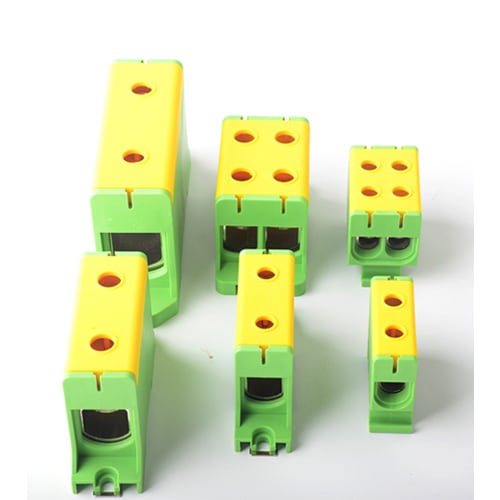
Yes, but only when the exact distribution block is identified for aluminum conductors. A terminal opening that fits the wire does not prove compatibility. You must check the conductor marking, permitted wire range, current rating, preparation method, torque, and model documentation before you approve the connection.
The Short Answer
Use an aluminum conductor only when the product data clearly permits aluminum or Al/Cu conductors. Use copper wire when the block is marked Cu-only.
Do not make the decision from the housing color, terminal size, conductive metal, or rated current alone. Two distribution blocks can look similar while using different contact surfaces, clamping structures, conductor ranges, and installation instructions.
The distinction also applies within the same manufacturer’s range. JINH’s JHT5 family includes models documented for aluminum and copper conductors. The JHUKK series is for copper conductors and cannot connect aluminum wire.
This simple rule prevents a common mistake: selecting a block by ampere rating and assuming that every conductor material within the physical opening is acceptable.
What Do Cu, Al, and Al/Cu Mean?
These markings describe the conductor material permitted at the terminal. They should be tied to the exact model, not just the product family name.
| Marking or documentation | What it normally means | What you should verify |
|---|---|---|
| Cu or Cu-only | Copper conductors are permitted | Copper wire range, construction, current rating, and torque |
| Al or Al-only | Aluminum conductors are permitted | Aluminum wire range, alloy or construction limits, preparation, and rating |
| Al/Cu or Cu/Al | Aluminum and copper conductors are permitted under the stated conditions | Separate wire ranges, current values, torque, and whether both materials may share one block |
| No conductor marking | Compatibility is not established | Request the data sheet and model-level evidence before use |
The marking tells you which material may enter the terminal. It does not mean that copper and aluminum use the same wire range or current value. It also does not mean that two different conductor materials may be placed together in one terminal opening.
Check the product data for each connection point. A block may have different line and load terminal sizes. One opening may accept a larger conductor than another, even though both belong to the same product.
Why Does Aluminum Need a Compatible Terminal?
Aluminum is not simply a lighter version of copper. Its surface and mechanical behavior create different connection requirements.
Aluminum forms an oxide layer
Fresh aluminum develops an oxide layer when exposed to air. That layer is poorly conductive. If the connection system does not control the interface correctly, contact resistance can increase.
This matters because heat at a connection rises with current and resistance. The relationship is commonly written as:
P = I²R
A small resistance increase can therefore have a larger heating effect when current is high. The practical response is not to apply a universal cleaning method. You should use a terminal designed for aluminum and follow its stated conductor-preparation procedure.
Some compatible products use a prepared contact chamber, suitable plating, contact paste, or another manufacturer-defined method. These features are product-specific. Never add paste, scrape a conductor, or change the assembly process unless the terminal instructions require it.
Aluminum and copper behave differently under pressure
Aluminum is softer than copper. Under long-term pressure, it can slowly change shape, and it expands at a different rate as temperature changes. A terminal intended for aluminum must maintain an appropriate contact interface through clamping force, load cycles, and temperature changes.
This is why terminal geometry, screw design, surface treatment, and torque cannot be separated from conductor compatibility. A copper-only clamp may physically hold aluminum without providing the performance expected from an Al/Cu connection.
Aluminum has lower conductivity than copper
An aluminum conductor and a copper conductor with the same cross-sectional area do not automatically carry the same permitted current in a connection system. Product data may therefore show different ratings for the two materials.
For example, the published JHT5 technical data separates copper and aluminum conductor ranges and lists material-specific current values for some models. Use those model-level values instead of transferring the copper rating to aluminum.
Can You Connect Copper and Aluminum in the Same Distribution Block?
You can use both materials only when the block is documented for that arrangement. The term Al/Cu tells you that the terminal system is designed for both conductor materials under specified conditions. It does not remove the need to check the circuit layout.
Confirm three separate points:
- Material permission: Does the exact model accept both aluminum and copper?
- Connection arrangement: Does each conductor use its own approved terminal opening, or does the documentation permit another arrangement?
- Electrical data: What wire range and current value apply to each material?
Do not place copper and aluminum conductors together in one opening unless the product documentation explicitly permits that combination. A terminal that accepts either material individually does not automatically allow two conductors or mixed materials under one clamp.
If the design changes from an aluminum feeder to copper branch conductors, show that transition on the wiring drawing. This helps you review the block, conductor sizes, protective devices, and installation instructions as one system.
Why Physical Fit Is Not Proof of Compatibility

A conductor can enter a terminal and still be wrong for the product. Physical fit answers only one question: can the wire enter the opening? It does not confirm:
- The permitted conductor material
- The minimum and maximum cross-section
- Solid, stranded, compacted, or flexible construction
- The rated current for that conductor
- The required tightening torque
- The stripping length
- The need for contact preparation
- The number of conductors permitted in the opening
- Certification or project acceptance
This distinction becomes important when you compare samples. A large opening can make an incompatible wire look acceptable during a quick assembly trial. The problem may appear later as unstable torque, conductor movement, voltage drop, or excessive temperature rise.
Your sample check should therefore compare the actual conductor with the model data before you judge the mechanical fit.
How to Read an Al/Cu Distribution Block Data Sheet
Read the data in a fixed order. This keeps one attractive specification from hiding a mismatch elsewhere.
1. Confirm the exact model number
Do not approve a family name alone. Different sizes in one series may have different conductor ranges, currents, dimensions, or mounting methods.
Match the model number on the quotation, data sheet, drawing, sample label, packaging, certificate, and test document. If one document uses only a series name, ask for the exact model scope.
2. Find separate copper and aluminum wire ranges
Look for distinct Cu and Al values. Do not assume that the minimum and maximum cross-sections are identical.
The JINH JHT5 technical sheet, for example, gives separate conductor ranges for copper and aluminum. The specific range changes by model. This is the type of model-level evidence you need before selecting the JHT5-150 Al/Cu distribution block or another size in the family.
3. Compare the current values by conductor material
If the data sheet gives one current for copper and another for aluminum, keep both values in your comparison table. Do not quote only the larger number.
The complete circuit may have a lower limit from the conductor, terminal, protective device, or another component. The usable design current cannot exceed the lowest applicable limit.
4. Check conductor construction
Aluminum conductors can be solid, stranded, or compacted. A cross-section alone does not confirm that every construction is allowed.
Ask the supplier to identify the permitted conductor class or construction. Then compare it with the actual cable specification, not a generic wire sample.
5. Check preparation and tightening instructions
Look for:
- Strip length
- Cleaning or oxide-removal requirements
- Approved contact compound, if required
- Tightening torque
- Tool size
- Retightening instructions, if any
- Limits on conductor reuse
Use only the method stated for that model. A procedure from another brand or series is not automatically transferable.
6. Check the installation environment
Temperature, moisture, contamination, and enclosure conditions can affect the connection. If the instructions limit aluminum use to a particular environment, include that limit in the project specification and inspection plan.
JHT5 and JHUKK: Do Not Treat Them as the Same Conductor System

JINH offers more than one distribution block structure. The product family must match the conductor material.
| Product family | Conductor-material position | Selection use |
|---|---|---|
| JHT5 | Published models support aluminum and copper conductors under model-specific data | Use when the design requires documented Al/Cu compatibility |
| JHUKK | Copper conductors only; aluminum wire is not permitted | Use when the conductor schedule is copper and the exact model fits the required current, wire range, and layout |
This difference should appear in your quotation request and internal part description. A phrase such as “high-current distribution block” is too broad because it does not preserve the conductor-material requirement.
For a JHUKK project, specify copper conductor sizes and keep aluminum out of the sample test. For an Al/Cu project, request the applicable JHT5 model data and test the real aluminum cable intended for production.
A Practical Selection Sequence
Use the following sequence before you request a sample:
- Confirm whether the incoming and outgoing conductors are copper or aluminum.
- Record each conductor’s cross-section in mm² and, where relevant, AWG or kcmil.
- Record the conductor construction and cable standard.
- Determine how many inputs and outputs are required.
- Select only models documented for the conductor material.
- Compare the permitted wire range at every opening.
- Compare the current rating for the selected material.
- Check voltage, mounting, dimensions, and conductor-routing space.
- Obtain the stripping, preparation, and torque instructions.
- Validate the exact cable and terminal combination on a sample.
This order reduces wasted sample cycles. It also helps you avoid receiving a copper-only block for an aluminum-cable project simply because the requested current and terminal size appeared to match.
How to Validate a Sample Before Approval
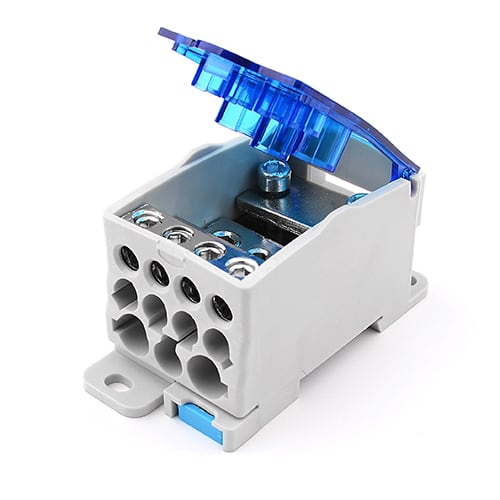
Use the cable, tool, and installation process planned for production. A substitute copper cable cannot validate an aluminum connection.
Check the documents first
Before assembly, compare:
- Product model and marking
- Cu, Al, or Al/Cu identification
- Permitted conductor range
- Material-specific current value
- Strip length and torque
- Preparation instructions
- Drawing and dimensions
- Applicable model-level test or certification documents
Record document revision dates. If a later shipment arrives with different instructions or markings, you can identify the change.
Check the connection process
Confirm that the actual cable enters to the intended depth and that the conductor is clamped without visible strand damage or insulation entering the contact area. Use the specified tool and torque.
Do not improvise the preparation procedure. If the data is missing, stop the validation and request it. An undocumented method makes the sample result difficult to repeat in production.
Check the assembled system
Inspect conductor routing, bending space, cover clearance, and access for the installation tool. Review the connection under the project’s required electrical and thermal validation plan.
The purpose of this test is not only to see whether the wire stays in place. It is to confirm that the complete documented process can be repeated across production batches.
What to Include in Your RFQ
Send enough information for a model-level answer:
- Incoming conductor material, construction, and size
- Every outgoing conductor material, construction, and size
- Continuous design current and any relevant load profile
- System voltage
- Required input and output configuration
- Mounting method and available space
- Operating temperature and enclosure conditions
- Target standards or market requirements
- Required documents and sample quantity
- Packaging, labeling, and change-control requirements
Ask the supplier to return a completed comparison against each line. A quotation that lists only model, price, and rated current is not enough for conductor-material approval.
If you are still deciding between a compact block and a wider distribution system, the power distribution block vs busbar guide explains the layout difference. For cabinet-level selection factors, see power distribution blocks for control panels.
Common Mistakes to Avoid
Assuming a metal body proves compatibility
The internal metal may be aluminum, copper, brass, or plated material. That fact alone does not identify which conductor may be connected. Use the product marking and data sheet.
Using the copper current rating for aluminum
Material-specific ratings can differ. Record the value that applies to the actual conductor.
Treating contact paste as a universal fix
Contact paste cannot convert an undocumented copper-only terminal into an aluminum-rated product. Use it only where the manufacturer specifies the product and procedure.
Ignoring conductor construction
An Al/Cu label does not automatically permit every solid, stranded, or compacted aluminum cable. Confirm the exact construction.
Approving the series instead of the model
Wire ranges, current ratings, and dimensions may change within one family. Keep the exact model number in every approval document.
Replacing the production cable during testing
A sample assembled with a different conductor does not prove compatibility. Test the real cable or an identical specification.
Conclusion
You can use aluminum wire only in a distribution block documented for aluminum or Al/Cu conductors. Confirm the exact model, wire range, material-specific current, preparation, and torque. Then validate the real cable and installation process before bulk approval.
FAQ
Can you put aluminum wire in any power distribution block?
No. The exact block must be identified for aluminum or Al/Cu conductors. A copper-only block is not suitable just because the wire fits its terminal opening.
What does Al/Cu mean on a distribution block?
It means the terminal system is documented for aluminum and copper conductors under stated conditions. You still need to check the permitted range, current value, construction, torque, and preparation for each material.
Can a copper-only distribution block be used with aluminum contact paste?
No. Contact paste does not change the product’s conductor rating. Use paste only with a compatible terminal and only as required by that terminal’s instructions.
Can JHUKK distribution blocks connect aluminum wire?
No. The JHUKK series is for copper conductors and cannot connect aluminum wire. Select a documented Al/Cu product when the project uses aluminum.
Does the JHT5 series accept both aluminum and copper?
Published JHT5 data includes models for aluminum and copper conductors. The permitted wire range and current depend on the exact model and conductor material, so check the model data before approval.
Can copper and aluminum share one terminal opening?
Only when the product documentation explicitly permits that arrangement. An Al/Cu rating does not automatically allow two conductors or mixed materials under one clamp.
Why can aluminum and copper have different current ratings in the same block?
The materials have different conductivity and connection behavior. Use the current value stated for the actual conductor instead of applying the copper value to aluminum.
What should you test before buying Al/Cu distribution blocks in bulk?
Verify the model documents, markings, real cable fit, preparation method, torque, routing space, and the project’s required electrical and thermal performance. Keep the approved process and document revisions with the part record.


